Couldn't find much on body donation stats, but for Victoria, organ donation stats can be found on the following website:
http://www.health.vic.gov.au/events/organdonate.pdf
and
http://www.medicareaustralia.gov.au/provider/patients/aodr/stats.jsp
Thursday, July 17, 2008

Requirements regarding Eleanor’s competence
Patient must understand the consequences of donating their body, and be able to make a decision based on that.
Key features of competence:
The patient should be able to:
· Understand what donation is (purpose and nature) in simple language
· Understand the main benefits and disadvantages and alternatives
· Retain this information long enough to make an effective decision
· Make a free choice
When the person contacts the institution to which they are donating their body, they must be rational. While cognitive impairment and mental illness do not necessarily mean someone is incompetent, and neither do irrational decisions, in the case of donating their body, it is generally accepted that they should not be suffering from an addiction or a mental disorder as it may impact their rationality.
In medical treatment, an evaluation of competence may have been carried out through a thorough medical assessment including mental and cognitive function.
Savulescu, Julian and Kerridge, Ian (2001) Competence and consent, in, Medical Journal of Australia 17th Sept/2001/v175 n6 p313-315
http://www.anatomy.unimelb.edu.au/aboutus/donorprogram/faq.html
Key features of competence:
The patient should be able to:
· Understand what donation is (purpose and nature) in simple language
· Understand the main benefits and disadvantages and alternatives
· Retain this information long enough to make an effective decision
· Make a free choice
When the person contacts the institution to which they are donating their body, they must be rational. While cognitive impairment and mental illness do not necessarily mean someone is incompetent, and neither do irrational decisions, in the case of donating their body, it is generally accepted that they should not be suffering from an addiction or a mental disorder as it may impact their rationality.
In medical treatment, an evaluation of competence may have been carried out through a thorough medical assessment including mental and cognitive function.
Savulescu, Julian and Kerridge, Ian (2001) Competence and consent, in, Medical Journal of Australia 17th Sept/2001/v175 n6 p313-315
http://www.anatomy.unimelb.edu.au/aboutus/donorprogram/faq.html
Plastination
The process of plastination, originally known as “Polymer Impregnation of Perishable”, is employed as a mean to preserve body parts, while retaining the texture and anatomical functions. Gunther von Hagens, most famous for his Body Worlds exhibitions, perfected the technique which allows medical students to interact with body parts without the need for gloves and dangers of toxic fumes.
Plastination techniques
• Originally body fluids cannot be replaced by polymers, but it is possible now if the water is replaced by acetone prior to getting the polymer into the specimen
o First step: Fixation, tissue preparation
Specimen suspended in formaldehyde solution, can be dissected or highlighted with coloured medium
o Second step: Freeze substitution
Placed in acetone, a volatile solvent, in -25oC for 4-5 weeks
The acetone replaces all water
o Third step: Forced impregnation
Body submerged in polymer, in a vacuumed container, which evaporates the acetone solvent and allows the desired polymer to permeate into the body
Takes a few days for thin body slices, weeks for whole bodies
o Forth step: position
Using wires, needles and clamps, the body can be positioned as desired
o Fifth step: Gas Cure (or other ways depending on the polymer used)
Specimen is exposed to curing gas, it hardens which takes a few months or up to one year
Uses in education
Like body parts preserved by means other than plastination, the specimen produced can aid in the teaching of anatomy and endoscopic techniques (using plastinated GI tract).
Body Worlds exhibitions
While plastination has the advantage of preserving cells in the microscopic level and is more durable, it has its own disadvantages: alteration of tissue characteristics and raises moral concerns in the community. Launched in 1997, there are many concerns over the commercialisation of human bodies and their effects on the public.
Sources:
http://humanbiology.curtin.edu.au/plastination.html
http://www.bodyworlds.com/en/plastination/plastination_process.html
The process of plastination, originally known as “Polymer Impregnation of Perishable”, is employed as a mean to preserve body parts, while retaining the texture and anatomical functions. Gunther von Hagens, most famous for his Body Worlds exhibitions, perfected the technique which allows medical students to interact with body parts without the need for gloves and dangers of toxic fumes.
Plastination techniques
• Originally body fluids cannot be replaced by polymers, but it is possible now if the water is replaced by acetone prior to getting the polymer into the specimen
o First step: Fixation, tissue preparation
Specimen suspended in formaldehyde solution, can be dissected or highlighted with coloured medium
o Second step: Freeze substitution
Placed in acetone, a volatile solvent, in -25oC for 4-5 weeks
The acetone replaces all water
o Third step: Forced impregnation
Body submerged in polymer, in a vacuumed container, which evaporates the acetone solvent and allows the desired polymer to permeate into the body
Takes a few days for thin body slices, weeks for whole bodies
o Forth step: position
Using wires, needles and clamps, the body can be positioned as desired
o Fifth step: Gas Cure (or other ways depending on the polymer used)
Specimen is exposed to curing gas, it hardens which takes a few months or up to one year
Uses in education
Like body parts preserved by means other than plastination, the specimen produced can aid in the teaching of anatomy and endoscopic techniques (using plastinated GI tract).
Body Worlds exhibitions
While plastination has the advantage of preserving cells in the microscopic level and is more durable, it has its own disadvantages: alteration of tissue characteristics and raises moral concerns in the community. Launched in 1997, there are many concerns over the commercialisation of human bodies and their effects on the public.
Sources:
http://humanbiology.curtin.edu.au/plastination.html
http://www.bodyworlds.com/en/plastination/plastination_process.html
Informed Consent & Health Tissue Act 1983
Informed Consent
- Tort Law - Battery: intentionally bringing about a harmful or offensive contact with another person’s body.
- In battery there is no need to prove any resulting injury because the failure to respect bodily integrity is in itself a crime recognised by law.
- Criminal aspect: indecent assault occurs when he/she touches another in indecent circumstances without their consent. E.g. touching breasts or genital area without consent à lead to criminal liability. In addition MPBV can de-register or suspend your license
Criteria Concerning valid legal consent:
1. Capacity to consent
2. Adequately informed
3. Voluntary
1) Patient must understand the information e.g. consequences, forgoing treatment. The pt must also use this information to reach a decision and communicate it to others.
Circumstances of reduced consent where an appropriate substitute must be found:
o Minors; under 18
o Adults with mental illness
o Adults with intellectual disabilities
o Adults with senility
o Unconscious patients
2) Legally in “broad terms of the nature” but must give risks and such
3) The consent must be given freely and voluntarily with no induction of coercion.
When consent can be legally waivered:
- Emergency situations: Only limited to life saving procedures administered to avoid serious and imminent threat to a pt’s life. If a relative or family of pt knows their wishes to consent/refuse treatment seek legal advice
- Necessity: when it is a necessity to act and not practical to talk to the patient. But the action must in the best interest of the patient seen by a reasonable person
Health Tissue Act 1983
"To provide for the donation or making available human bodies or tissue for the purpose of medical or dental training, research or therapy or the advancement of medicine or dentistry in general; for post-mortem examination of certain human bodies; for removal of tissue, blood and gametes from the bodies of living persons and the use thereof for medical or dental purposes; for control of artificial fertilization of persons; and regulation for the import and export of human tissue, blood and gametes; and to provide matters connected therewith. "
The Act :
- Makes consent the most important principle for the lawful retention and use of human tissue
- Establishes the Human Tissue Authority to:
- Advise on and ensure compliance with the Act
- Develop national operational procedures and guidelines
- Licence activities using human tissue
- Makes it an offence to have bodily material (which includes hair, nail and gametes in this context) with the intention of analysing the DNA, without the consent of the individual from which it was obtained (or those close to them if they have died)
- It is also hoped that it will improve public confidence, so that people will be more willing to agree to the use of tissues and organs in research.
http://www.kznhealth.gov.za/humantissueact.pdf
http://www3.imperial.ac.uk/clinicalresearchgovernanceoffice/researchgovernance/humantissueact
Med1011 Law Notes, Study Guide
Grief
Grief
Grief is a response people have when they lose something or someone of importance. Although a mainly emotional response, an upsetting stimulus may also cause physical, cognitive, behavioural and social reactions.
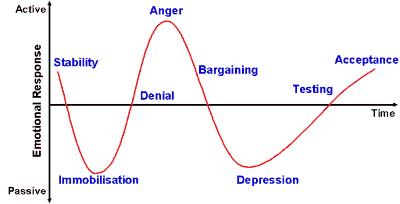
There are a large number of emotional responses to grief, but the most widely acknowledged model is the Kübler-Ross model of a grief cycle which details five main stages of a person’s response to a traumatic loss:
1. Denial – does not believe what is happening
2. Anger – frustrated outpouring of bottled up emotion
3. Bargaining – seeking to put off what is coming
4. Depression –realisation of the inevitable and depressed emotions
5. Acceptance – finally accepting fate and finding the way forward
However, variations of this model has included an initial ‘shock/immobilisation’ stage where the person is at first paralysed at hearing the news and also a ‘testing’ stage before acceptance where they experiment with ideas until they are satisfied there is nothing more they can do and thus finally accepts fate.
http://changingminds.org/images/kubler_ross.gif
The following is an extract from Victoria’s better health channel
Looking after yourself
http://www.mentalhealth.asn.au/resources/grief_and_loss.htm
http://www.medterms.com/script/main/art.asp?articlekey=38649
http://changingminds.org/disciplines/change_management/kubler_ross/kubler_ross.htm
http://www.betterhealth.vic.gov.au/BHCV2/bhcarticles.nsf/pages/Grief_everyone's_response_is_different?OpenDocument
Grief is a response people have when they lose something or someone of importance. Although a mainly emotional response, an upsetting stimulus may also cause physical, cognitive, behavioural and social reactions.
There are a large number of emotional responses to grief, but the most widely acknowledged model is the Kübler-Ross model of a grief cycle which details five main stages of a person’s response to a traumatic loss:
1. Denial – does not believe what is happening
2. Anger – frustrated outpouring of bottled up emotion
3. Bargaining – seeking to put off what is coming
4. Depression –realisation of the inevitable and depressed emotions
5. Acceptance – finally accepting fate and finding the way forward
However, variations of this model has included an initial ‘shock/immobilisation’ stage where the person is at first paralysed at hearing the news and also a ‘testing’ stage before acceptance where they experiment with ideas until they are satisfied there is nothing more they can do and thus finally accepts fate.
http://changingminds.org/images/kubler_ross.gif
The following is an extract from Victoria’s better health channel
Looking after yourself
Losing a loved one is a shattering event that affects you emotionally, physically and spiritually. Try to look after yourself. Suggestions include:
- Diet and exercise – grief impacts on the body and can cause symptoms such as sleeplessness, anxiety and gastrointestinal upsets. Take care of yourself by paying attention to diet and getting regular exercise. Make sure that you receive good medical care.
- Relaxation – schedule time every day to wind down, using whichever method works for you: for example, meditation, tai chi, taking a bath, playing sport, reading, attending to hobbies or listening to music.
- Avoid drugs – try to avoid turning to drugs such as cigarettes, alcohol or antidepressants to help you manage your grief. They won’t ease your pain and can cause other health problems.
- Be realistic – try to be kind and gentle to yourself. Accept that you need to grieve in the ways that feel natural to you. Don’t judge or criticise yourself for not coping as well as you think you should.
Coping Strategies
You may need to experiment to find out which strategies are most helpful for you. Suggestions include:
- Crying
- Time alone
- Time with your family
- Pampering
Support team
Memorial - Professional help
http://www.mentalhealth.asn.au/resources/grief_and_loss.htm
http://www.medterms.com/script/main/art.asp?articlekey=38649
http://changingminds.org/disciplines/change_management/kubler_ross/kubler_ross.htm
http://www.betterhealth.vic.gov.au/BHCV2/bhcarticles.nsf/pages/Grief_everyone's_response_is_different?OpenDocument
Wednesday, July 16, 2008
Grounds for Rejection
It appears that body bequest programs are run mainly by universities for teaching purposes. The criteria for acceptance and/or rejection vary from state to state, but the general grounds for rejection are as follows:
Cause of Death: most bodies accepted will have died of natural causes. The body is rejected if the donor had a notifiable disease (e.g. HIV, tuberculosis)
Autopsy: if an autopsy has been done, a body may not be accepted because the major arteries are severed, making embalming difficult
Organ Donor: if the donor has previously donated whole organs
Physical size and condition: embalming is difficult or ineffective if body is obese, emaciated, or has been dead for too long
Transportation limits: sometimes the family or donor must have arranged transport of the body to the university
Each university's specific guidelines are as below (UNSW didn't have much info soz)
Melbourne University (Victoria)
Once I become a donor is my body automatically accepted at the time of death?
The University appreciates your generous donation, but some circumstances may prevent the acceptance of your body. Where this is the case, the University will contact your executor, administrator, or next-of-kin so that alternative arrangements may be made. The University would be unable to accept your body if:
- an autopsy or post mortem has been performed
- too much time has elapsed before the University is notified of your death
- the cause of death is a significant disease (eg. HIV, tuberculosis)
- at the time of death organs were removed for organ donation
- recent surgery has been performed- death occurs more than 60 km from Melbourne GPO
Site: http://www.anatomy.unimelb.edu.au/aboutus/donorprogram/faq.html
University of Queensland (Queensland)
Conditions of Acceptance
We accept donations of human bodies from people who live and die in the greater Brisbane area as well as the Gold Coast, Sunshine Coast and Toowoomba. There is no upper age limit, however the applicant does have to be over the age of 18 to be accepted into the program. Other than the applicant’s residential address, the following conditions would restrict acceptance:-
- Death occurring outside of the acceptance area;
- Conduct of post mortem examination;
- Accidental death; - Coroner’s inquiry;
- Cause of death – transmissible disease or widespread cancer;
- Physical size and condition of body.
Site: http://www.uq.edu.au/sbms/human-bequest-program
Australian National University (Canberra)
5. What conditions will prevent the University from accepting my body?As we use donated bodies to study the NORMAL structure of the WHOLE human body, we may not be able to accept the body if the donor:
is obese or emaciated;
has been significantly altered by certain medical conditions or procedures* including amputation; has undergone an autopsy;
has been embalmed;
has undergone whole organ donation;
has Creutzfeld Jacob Disease (CJD), any form of dementia, or is suspected of having certain notifiable diseases;
has jaundice;
has been deceased for more than 72 hours or cannot be transferred to the ANU Anatomy Laboratories within 72 hours;
too great distance for body transportation (greater than 200Km radius of Canberra); and
laboratories storage limitations.
*Due to variations in procedures, exceptions may be made in some casesAfter the appropriate enquiries have been made, if the body is NOT suitable for donation, the next-of-kin will be notified immediately so they can make alternative funeral arrangements. The Universities cannot be held liable for any costs incurred through the refusal of a donation. It is incumbent upon the next-of-kin or the attending medical personnel, to obtain acceptance of the body prior to its transport.
Site: http://medicalschool.anu.edu.au/donation/donation.asp
Flinders University (Adelaide)
Q9. What conditions will prevent the University from accepting my body?
Whilst we reject some donations, the University accepts over 85% of intended body donations when we are notified of a death in the required timeframe.
We may not be able to accept the donation if the intending donor:
a) has been deceased for more than three (3) days;
b) has been significantly altered by certain medical conditions or procedures*, including amputation*;
c) has undergone an autopsy;
d) has undergone whole organ donation*;
e) has Creutzfeld-Jacob Disease (CJD), dementia of unknown cause, spent six months or more within the United Kingdom between the years 1980 to 1996 or is suspected of having communicable diseases;
f) has jaundice;
g) died within 24 hours of a surgical procedure or discharge from a hospital;
h) is obese or emaciated
i) cannot be transferred to the School of Medical Sciences within three (3) daysOR DUE TOj) body storage limitations;
k) planned university shutdowns (eg Christmas/New Year break).
*NB: The School may make exceptions in some cases.
**********************************************************
Site: http://som.flinders.edu.au/FUSA/Anatomy/BodyDonation.htm#9
University of Tasmania Body Bequest program (Tasmania)
The Program uses donated bodies to study the normal structure of the whole human body. Whilst we strive to accept all donations there may be times that a donor is not suitable because the normal structure has been altered by a medical condition. Such instances may arise because the donor:
is the subject of a coronial enquiry or a post mortem examination;
has had a recent operation prior to death;
has the possible existence of a contagious disease;
has undergone whole organ donation;
has Creutzfeld Jacob Disease (CJD);
is obese or emaciated;
has widespread cancer;
has been assessed to be unsuitable for embalming;
has been significantly altered by certain medical conditions or procedures.
All donations are considered on a case by case basis at the time of death and there may be exceptions in some cases. Donations cannot be accepted if the donor has been deceased more than 4 days or if the family do not wish the donation proceed. Donations may also not be accepted subject to the University's storage limitations.
Site: http://www.medicine.utas.edu.au/bodybequest/
Cause of Death: most bodies accepted will have died of natural causes. The body is rejected if the donor had a notifiable disease (e.g. HIV, tuberculosis)
Autopsy: if an autopsy has been done, a body may not be accepted because the major arteries are severed, making embalming difficult
Organ Donor: if the donor has previously donated whole organs
Physical size and condition: embalming is difficult or ineffective if body is obese, emaciated, or has been dead for too long
Transportation limits: sometimes the family or donor must have arranged transport of the body to the university
Each university's specific guidelines are as below (UNSW didn't have much info soz)
Melbourne University (Victoria)
Once I become a donor is my body automatically accepted at the time of death?
The University appreciates your generous donation, but some circumstances may prevent the acceptance of your body. Where this is the case, the University will contact your executor, administrator, or next-of-kin so that alternative arrangements may be made. The University would be unable to accept your body if:
- an autopsy or post mortem has been performed
- too much time has elapsed before the University is notified of your death
- the cause of death is a significant disease (eg. HIV, tuberculosis)
- at the time of death organs were removed for organ donation
- recent surgery has been performed- death occurs more than 60 km from Melbourne GPO
Site: http://www.anatomy.unimelb.edu.au/aboutus/donorprogram/faq.html
University of Queensland (Queensland)
Conditions of Acceptance
We accept donations of human bodies from people who live and die in the greater Brisbane area as well as the Gold Coast, Sunshine Coast and Toowoomba. There is no upper age limit, however the applicant does have to be over the age of 18 to be accepted into the program. Other than the applicant’s residential address, the following conditions would restrict acceptance:-
- Death occurring outside of the acceptance area;
- Conduct of post mortem examination;
- Accidental death; - Coroner’s inquiry;
- Cause of death – transmissible disease or widespread cancer;
- Physical size and condition of body.
Site: http://www.uq.edu.au/sbms/human-bequest-program
Australian National University (Canberra)
5. What conditions will prevent the University from accepting my body?As we use donated bodies to study the NORMAL structure of the WHOLE human body, we may not be able to accept the body if the donor:
is obese or emaciated;
has been significantly altered by certain medical conditions or procedures* including amputation; has undergone an autopsy;
has been embalmed;
has undergone whole organ donation;
has Creutzfeld Jacob Disease (CJD), any form of dementia, or is suspected of having certain notifiable diseases;
has jaundice;
has been deceased for more than 72 hours or cannot be transferred to the ANU Anatomy Laboratories within 72 hours;
too great distance for body transportation (greater than 200Km radius of Canberra); and
laboratories storage limitations.
*Due to variations in procedures, exceptions may be made in some casesAfter the appropriate enquiries have been made, if the body is NOT suitable for donation, the next-of-kin will be notified immediately so they can make alternative funeral arrangements. The Universities cannot be held liable for any costs incurred through the refusal of a donation. It is incumbent upon the next-of-kin or the attending medical personnel, to obtain acceptance of the body prior to its transport.
Site: http://medicalschool.anu.edu.au/donation/donation.asp
Flinders University (Adelaide)
Q9. What conditions will prevent the University from accepting my body?
Whilst we reject some donations, the University accepts over 85% of intended body donations when we are notified of a death in the required timeframe.
We may not be able to accept the donation if the intending donor:
a) has been deceased for more than three (3) days;
b) has been significantly altered by certain medical conditions or procedures*, including amputation*;
c) has undergone an autopsy;
d) has undergone whole organ donation*;
e) has Creutzfeld-Jacob Disease (CJD), dementia of unknown cause, spent six months or more within the United Kingdom between the years 1980 to 1996 or is suspected of having communicable diseases;
f) has jaundice;
g) died within 24 hours of a surgical procedure or discharge from a hospital;
h) is obese or emaciated
i) cannot be transferred to the School of Medical Sciences within three (3) daysOR DUE TOj) body storage limitations;
k) planned university shutdowns (eg Christmas/New Year break).
*NB: The School may make exceptions in some cases.
**********************************************************
Site: http://som.flinders.edu.au/FUSA/Anatomy/BodyDonation.htm#9
University of Tasmania Body Bequest program (Tasmania)
The Program uses donated bodies to study the normal structure of the whole human body. Whilst we strive to accept all donations there may be times that a donor is not suitable because the normal structure has been altered by a medical condition. Such instances may arise because the donor:
is the subject of a coronial enquiry or a post mortem examination;
has had a recent operation prior to death;
has the possible existence of a contagious disease;
has undergone whole organ donation;
has Creutzfeld Jacob Disease (CJD);
is obese or emaciated;
has widespread cancer;
has been assessed to be unsuitable for embalming;
has been significantly altered by certain medical conditions or procedures.
All donations are considered on a case by case basis at the time of death and there may be exceptions in some cases. Donations cannot be accepted if the donor has been deceased more than 4 days or if the family do not wish the donation proceed. Donations may also not be accepted subject to the University's storage limitations.
Site: http://www.medicine.utas.edu.au/bodybequest/
Abnormal reactions to the loss of a loved one
Abnormal Grief
Abnormal, often referred to as complicated grief, is found in only 3 to 25 percent of loss survivors.
Such grief is manifested in behaviours such as the person not acknowledging the reality of the loss, not allowing him/herself to experience the pain of grief, being unable to adjust to living without the deceased loved one, or being unable to move on and thus not having the energy to adjust to life without the loved one.
Risk factors for abnormal grief:
- Social isolation
- History of mental illness
- Presence of previous unresolved grief
- Suddenness of the loss
- Gender of the bereaved
- Existence of an intense, overly close or highly ambivalent relationship with the loved one
There are different types of abnormal grief:
- Absent grief – when there appears to be no signs of grief in the person following the loss.
- Inhibited grief – there are some signs that the person is grieving, but fewer than you expect, given the nature of the loss.
- Unbalanced grief – the person is clearly grieving, but seem to be stuck in a particular emotion.
- Chronic/dependent grief – the grieving person has trouble finding closure and returning to normal activities over an extended amount of time. Occurs when grieving person’s identity and self-imaged are too heavily enmeshed in the lost loved one. This is the most common form of abnormal grief, and typically affects long time married women who were homemakers.
- Delayed grief – the intentional postponement of grief. Sometimes this is related to other life events or losses that drain one’s ability to work through the grief process. Person usually finds him/herself overwhelmed with grief after a few months.
- Disenfranchised grief – often occurs when a grieving person’s loss can’t be openly acknowledged or is one that society does not accept as a real. Examples include losses related to AIDS, miscarriage, or loss of a homosexual partner.
- Exaggerated grief – intense reactions of grief that may include nightmares, delinquent behaviors, phobias (abnormal fears), and thoughts of suicide.
- Distorted/unexpected loss/sudden grief – when death takes place very suddenly without warning, with sudden and unnatural causes like suicide, homicide and accidents. Sudden grief can lead to exaggerated reactions and PTSD. Women are more prone to PTSD, and can experience easy startling, flashbacks, nightmares, and recurrent thoughts of the death, as well as flattened emotional response and numbing. Required participation in official investigations or trials related to the death can promote this sort of grief. The three Vs -- violence, violation, and volition make a woman high risk. That means if the death was caused by violence, if the loved one was a victim in some way, and/or woman gets preoccupied with establishing blame or bringing justice to her loved one. If there is media coverage of the death and/or illegal or socially unacceptable behaviours of the loved one involved, women are also at higher risk.
- Conflicted grief – when the grieving person has mixed feelings about the loss. Typical situations involve death of a parent, particularly for women who are caregivers for the parent. Often today’s middle-aged women have done more than their share of caring for their aged parents, yet they grew up in families where their brothers were favoured. This gap, as well as any unresolved issues with parents, causes unresolved conflict that may arise at the parent’s death. Unexpressed anger can turn towards the person him/herself and lead to depression. Another common situation for women is death of a child through violence, suicide or accident. She may experience anger at the child for his/her role in the death, but also feel that her upbringing of the child was inadequate.
Adjustment disorders (especially depressed and anxious mood or disturbance of emotions and conduct), major depression, substance abuse, and post-traumatic stress disorder are some of the more common psychiatric sequelae of complicated bereavement. Grief that becomes pathologic is often identifiable by lingering symptoms (listed below), increased disruption of psychosocial functioning caused by the symptoms, or the intensity of subsyndromal symptoms (e.g., intense suicidal thoughts or acts upon the loss).
Grief can take a toll on a person’s emotional health, and the grieving person should see a doctor if they experience any of the following symptoms for more than two weeks:
• Memory gaps
• Distraction or lack of concentration
• Irritability
•Sadness, hopelessness or depression
• Euphoria
•Violent, weeping rages
•Passive resignation
•Numbness
•Tightness in the throat or chest
•Shortness of breath
•Sensitivity to loud noises
•Agitation and restlessness
•Exhaustion
•Headaches
•Upset stomach
http://yourhealth.goodshepherdhealth.org/HealthTopics/caregiver/Oct03ccMain.htm
http://www.cancer.gov/cancertopics/pdq/supportivecare/bereavement/HealthProfessional/page8
www.library.nhs.uk/
http://dying.about.com/od/thegrievingprocess/a/griefprocess.htm
http://www.womenshealth.org/a/women_grief_mourning.htm
http://www.norfolk.nhs.uk/specialist_directory/bereavement/grieving_tasks.htm#What%20is%20complicated%20grief
PCL 1 – Coping Strategies
Grief is obviously a major life-altering emotion in those who have, recently or otherwise, experienced the loss of a loved one. It is important to manage this grief in a healthy way, as not doing so will extend the period of sorrow, and may carry further psychological, or even physical and mental problems.
Some common coping mechanisms are:
1) Scheduling a specific time to grieve – It is important not to ignore grief, as putting way what is at the forefront of your mind will only hinder the healing process. You may spend this time reminiscing about the good times shared with the lost one, or perhaps start a journal to describe feelings. This can be described as ‘intentional grieving’.
2) Looking to faith – Religious or other faith-based organizations may provide additional strength or purpose to help overcome difficult periods of grief.
3) Talk to friends and family – It is crucial that you maintain contact with those close to you, and not isolate yourself. It is a lot easier to overcome grief if there is someone who is willing to listen. It may also help the process if you grieve with someone, rather than individually.
4) Join Support Groups – there are several grief support groups, where it is possible to express your feelings to those who are likely to understand your situation.
5) Self-care – This is especially important to avoid further stress to the body. A balanced diet is very important; do not binge eat or fast excessively. Outdoor activities such as regular walks can help refresh you. Avoid too much coffee, tea, or other caffeinated substances as these may interfere with sleep.
You should avoid unhealthy coping mechanisms such as alcohol and drugs, as these will only serve to temporarily delay guilt. They are also likely to increase anger and decrease pleasure in everyday activities. You should also avoid isolating yourself from others, as it is more difficult to overcome grief alone. Additionally, you should avoid making major decisions while emotionally distressed, such as buying or selling a house, marrying, etc., as your emotions may affect your judgement.
http://www.squidoo.com/coping-with-grief
Normal reactions to the loss of a loved one
Grief from the loss of a loved one can manifest in many ways such as emotionally, physically, cognitively and behaviorally.
Some normal reactions can for example are:
Emotional
Sadness
Anxiety or fear
Irritability or restlessness
Numbness or detachment
Guilt
Shock
Relief (if there was no suffering or a release from it)
Physical
Headaches
Nausea
Fatigue
Sleeplessness
Cognitive
Concentration difficulties
Forgetfulness
Confusion
Disorientation
Distraction
Behaviour
Avoidance
Social withdrawal
Increase or decreased activeness
Loss of appetite
Insomnia
Some normal reactions can for example are:
Emotional
Sadness
Anxiety or fear
Irritability or restlessness
Numbness or detachment
Guilt
Shock
Relief (if there was no suffering or a release from it)
Physical
Headaches
Nausea
Fatigue
Sleeplessness
Cognitive
Concentration difficulties
Forgetfulness
Confusion
Disorientation
Distraction
Behaviour
Avoidance
Social withdrawal
Increase or decreased activeness
Loss of appetite
Insomnia
The duration and severity of the grief is also influenced by factors such as the age or cause of death. For example the loss of a child in an accident may cause intense grieving that lasts for years.
Sources
Psychology : An Introduction, Russell A. Dewey. PhD 2008
http://www.intropsych.com/index.html
University of Illinois Counseling Centre
http://www.counselingcenter.uiuc.edu/?page_id=312
Grief Watch : Grief Facts
http://www.griefwatch.com/info/normal_reactions_to_loss.htm
Sources
Psychology : An Introduction, Russell A. Dewey. PhD 2008
http://www.intropsych.com/index.html
University of Illinois Counseling Centre
http://www.counselingcenter.uiuc.edu/?page_id=312
Grief Watch : Grief Facts
http://www.griefwatch.com/info/normal_reactions_to_loss.htm
Summary of relevant parts of the Human Tissue Act 1982
Part IV – donation of tissue after death
Section 25 – Effect of authority under section 26:
- Dr (or person with appropriate authority) other than the person who gave authority/ certificate to allow removal of tissues can remove the tissue.
Section 26 – Authority to remove tissue after death:
- Similar process whether died in hospital or not
- Appropriate person can authorise removal of tissue for:
o The purpose of transplantation of living tissue or
o Use in other “therapeutic or for medical or scientific purposes”
- Can be given when the
o deceased gave either written consent (at any time in life) or oral (during last illness, with two witnesses present) – same process applies for not allowing removal of tissue
o next of kin tells the authorised person that they give consent
o designated officer believes it to be ok (“after making such enquiries as are reasonable in the circumstances”) and consents
- The designated officer cannot also be the person’s next of kin
- If the designated officer gives consent according to the deceased’s wishes, they have to notify the next of kin ASAP, but it can be after removal of tissues.
- Next of kin can give consent on behalf of an unconscious patient, but this is no longer valid if the patient later regains consciousness.
- The designated officer can’t give consent unless:
o Patient “not being maintained by artificial means” has been certified dead by one registered medical practitioner.
o Patient “being maintained by artificial means” is said to have “irreversible cessation of all function of the brain” by two medical practitioners, each of whom have been registered over 5 years.
Section 27 – Consent by a coroner:
- If the death must be reported to the coroner removal of tissue can’t be authorised until the coroner consents.
- The coroner can consent either before or after the death of the person
Part VI – donations for anatomical purposes
Section 32 – Authority for anatomy:
- Where the designated officer checks that the patient “expressed the wish for, or consented to, the retention after death of his body” they may authorise it (can’t if the patient – as for tissue donation – specifically said no), either in hospital or not
- Use of body is for anatomical examination or study/ teaching of anatomy
- If can’t contact next of kin the designated officer can give consent for retention of body but must notify next of kin ASAP
Section 25 – Effect of authority under section 26:
- Dr (or person with appropriate authority) other than the person who gave authority/ certificate to allow removal of tissues can remove the tissue.
Section 26 – Authority to remove tissue after death:
- Similar process whether died in hospital or not
- Appropriate person can authorise removal of tissue for:
o The purpose of transplantation of living tissue or
o Use in other “therapeutic or for medical or scientific purposes”
- Can be given when the
o deceased gave either written consent (at any time in life) or oral (during last illness, with two witnesses present) – same process applies for not allowing removal of tissue
o next of kin tells the authorised person that they give consent
o designated officer believes it to be ok (“after making such enquiries as are reasonable in the circumstances”) and consents
- The designated officer cannot also be the person’s next of kin
- If the designated officer gives consent according to the deceased’s wishes, they have to notify the next of kin ASAP, but it can be after removal of tissues.
- Next of kin can give consent on behalf of an unconscious patient, but this is no longer valid if the patient later regains consciousness.
- The designated officer can’t give consent unless:
o Patient “not being maintained by artificial means” has been certified dead by one registered medical practitioner.
o Patient “being maintained by artificial means” is said to have “irreversible cessation of all function of the brain” by two medical practitioners, each of whom have been registered over 5 years.
Section 27 – Consent by a coroner:
- If the death must be reported to the coroner removal of tissue can’t be authorised until the coroner consents.
- The coroner can consent either before or after the death of the person
Part VI – donations for anatomical purposes
Section 32 – Authority for anatomy:
- Where the designated officer checks that the patient “expressed the wish for, or consented to, the retention after death of his body” they may authorise it (can’t if the patient – as for tissue donation – specifically said no), either in hospital or not
- Use of body is for anatomical examination or study/ teaching of anatomy
- If can’t contact next of kin the designated officer can give consent for retention of body but must notify next of kin ASAP
Religious and Cultural view on body donation
PCL – Religious and cultural views on Organ donation
Amish:
The Amish consent to donation if they know it is for the health and welfare of the transplant recipient. They may be reluctant to consent if the transplant outcome is known to be questionable.
Baptist:
Donation is supported as an act of charity and the church leaves the decision to donate up to the individual.
Buddhism:
Buddhists believe that organ/tissue donation is a matter of individual conscience and place high value on acts of compassion.
Catholicism:
Roman Catholics view donation as an act of charity, fraternal love and self-sacrifice. Transplants are ethically and morally acceptable to the Vatican.
Greek Orthodox:
According to Reverend Dr. Milton Efthimiou, Director of the Department of Church and Society for the Greek Orthodox Church of North and South America, “The Greek Orthodox Church is not opposed to organ donation as long as the organs and tissue in question are used to better human life, i.e., for transplantation or for research that will lead to improvements in the treatment and prevention of disease.”
Hinduism:
According to the Hindu Temple Society of North America religious law does not prohibit Hindus from donating their organs; this act is an individual’s decision.
Independent Conservative Evangelical:
Generally, Evangelicals have no opposition to organ and tissue donation. Each church is autonomous and leaves the decision to donate up to the individual.
Islam:
In 1983, the Moslem Religious Council initially rejected organ donation by followers of Islam, but it has revised its position, provided donors consent in writing before their death.
Jehovah’s Witnesses:
According to their National Headquarters, the Watch Tower Society, Jehovah’s Witnesses believe donation is a matter of individual decision. Jehovah’s Witnesses are often assumed to be opposed to donation because of their belief against blood transfusion. However, this merely means that all blood must be removed from the organs and tissues before being transplanted.
Judaism:
All four branches of Judaism (Orthodox, Conservative, Reform, and Reconstructionist) support and encourage donation.
Lutheran:
In 1984, the Lutheran Church in America (Missouri-Synod) passed a resolution stating that donation contributes to the well-being of humanity and can be “an expression of sacrificial love for a neighbor in need.” They call on “members to consider donating organs and to make any necessary family and legal arrangements, including the use of a signed donor card.”
Pentecostal:
Pentecostals believe that the decision to donate should be left up to the individual.
Presbyterian:
Presbyterians encourage and support donation. They respect a person’s right to make decisions regarding their own body.
Seventh-Day Adventist:
Donation and transplantation are strongly encouraged by Seventh-Day Adventists.
Cultural Views
I could not find a specific source on different cultural views on body donation, however I found and read many chat rooms discussing the issue. The two main views held seemed to be that for many people the idea of being cut-up after death was uncomfortable and so did not wish to donate. However there were also a significant proportion of people who believed that the body was a left over husk and should be used in a way to benefit other people.
References
http://www.ctorganandtissuedonation.org/religious_views.html
Amish:
The Amish consent to donation if they know it is for the health and welfare of the transplant recipient. They may be reluctant to consent if the transplant outcome is known to be questionable.
Baptist:
Donation is supported as an act of charity and the church leaves the decision to donate up to the individual.
Buddhism:
Buddhists believe that organ/tissue donation is a matter of individual conscience and place high value on acts of compassion.
Catholicism:
Roman Catholics view donation as an act of charity, fraternal love and self-sacrifice. Transplants are ethically and morally acceptable to the Vatican.
Greek Orthodox:
According to Reverend Dr. Milton Efthimiou, Director of the Department of Church and Society for the Greek Orthodox Church of North and South America, “The Greek Orthodox Church is not opposed to organ donation as long as the organs and tissue in question are used to better human life, i.e., for transplantation or for research that will lead to improvements in the treatment and prevention of disease.”
Hinduism:
According to the Hindu Temple Society of North America religious law does not prohibit Hindus from donating their organs; this act is an individual’s decision.
Independent Conservative Evangelical:
Generally, Evangelicals have no opposition to organ and tissue donation. Each church is autonomous and leaves the decision to donate up to the individual.
Islam:
In 1983, the Moslem Religious Council initially rejected organ donation by followers of Islam, but it has revised its position, provided donors consent in writing before their death.
Jehovah’s Witnesses:
According to their National Headquarters, the Watch Tower Society, Jehovah’s Witnesses believe donation is a matter of individual decision. Jehovah’s Witnesses are often assumed to be opposed to donation because of their belief against blood transfusion. However, this merely means that all blood must be removed from the organs and tissues before being transplanted.
Judaism:
All four branches of Judaism (Orthodox, Conservative, Reform, and Reconstructionist) support and encourage donation.
Lutheran:
In 1984, the Lutheran Church in America (Missouri-Synod) passed a resolution stating that donation contributes to the well-being of humanity and can be “an expression of sacrificial love for a neighbor in need.” They call on “members to consider donating organs and to make any necessary family and legal arrangements, including the use of a signed donor card.”
Pentecostal:
Pentecostals believe that the decision to donate should be left up to the individual.
Presbyterian:
Presbyterians encourage and support donation. They respect a person’s right to make decisions regarding their own body.
Seventh-Day Adventist:
Donation and transplantation are strongly encouraged by Seventh-Day Adventists.
Cultural Views
I could not find a specific source on different cultural views on body donation, however I found and read many chat rooms discussing the issue. The two main views held seemed to be that for many people the idea of being cut-up after death was uncomfortable and so did not wish to donate. However there were also a significant proportion of people who believed that the body was a left over husk and should be used in a way to benefit other people.
References
http://www.ctorganandtissuedonation.org/religious_views.html
Tuesday, July 15, 2008
PCL 1 -- Process of embalming bodies
PRE-EMBALMING
An embalming report is filled out, which
1. Logs all jewellery and personal items on the body;
2. Details any discolorations, cuts, bruises, etc. on the body;
3. Documents the procedures and chemicals used during embalming.
All clothing, bandages, IV needles, catheters etc are removed. A strong disinfectant spray is used to clean the skin, eyes, mouth, and other orifices.
If rigor mortis (the stiffening of muscles after death) has set in, it is relieved by moving the limbs and head about and massaging the muscles.
If the decedent is a man, he is normally shaved at this point. Razor burn is less likely before the arterial chemical firms the skin of the face). Even women and children are shaved to remove the fine "peach fuzz" on the faces. This is done to avoid the makeup from collecting on the hair and making the makeup more noticeable.
FEATURE SETTING
The embalmer places the remains straight from head to toe on the embalming table. The arms are held in position, usually with hands folded across the stomach, by a special positioning device. The head is placed on a head block, and many embalmers will tilt the head 15 degrees to the right so mourners can see the face more easily.
The traditional method for closing the eyes involves placing a bit of cotton between the eye and eyelid. The eyes can sink back into their sockets, so in order to prevent this, small plastic "eye caps" are placed on each eye ball. An eye cap is shaped like a large contact lens and has a textured surface that grips and holds the eyelid in place. A small amount of stay cream is placed on the eye cap to avoid dehydration of the eyelids. Contrary to popular myth, the eyelids are never sewn shut, but in some cases, they may be glued together to prevent separation
The mouth is closed either by tying the jaw together with a piece of suture string or by a special injector gun. With the suture method, a curved needle with a piece of suture string is threaded through the jaw below the gums, stuck through the upper jaw into the right nostril, threaded through the septum of the nose into the left nostril, and then passed back down into the mouth. The two ends of suture are tied, being careful not to tie it too tightly, so that a natural appearance of the mouth is created. Some embalmers prefer to close the mouth using the needle injector gun. The gun drives a needle with a piece of wire attached into the jaw. Needles are driven into both the lower and upper jaw and then twisted together.
To finish closing the mouth, usually a mouth former is used. A mouth former is similar to an eye cap as it has a textured side that grips the lips, but it is shaped like the mouth. A small amount of stay cream is also used on the mouth to avoid dehydration and help hold the lips in place. The mortician may also squeeze the inside of the mouth with a little mastic compound, a paste kind of like caulk to give the mouth a better and more pleasing shape.
ARTERIAL EMBALMING
Arterial embalming begins by selecting an artery to inject the fluid into and a vein to drain away blood. The most popular site (although multiple injection and drainage sites may be used) is on the right side of the body near the collarbone, where the right common carotid artery and the right internal jugular vein are located. A small incision is made just deep enough to cut the skin and an aneurysm hook is used to separate the tissue above the vein and artery. The embalmer raises the artery above the skin surface and passes two pieces of suture string beneath it to create a ligature to tie off the vessel once the arterial tube is inserted. The same is done with the vein.
Each vessel will receive a tube to facilitate injection and drainage. The artery is incised (very carefully as to not cut it in half) and an arterial canula (tube) is inserted into the artery towards the heart. The ligature is now tightened so that a seal is made between the tube and the artery. The same is done with the jugular drain tube. A clear hose is attached to the drain tube and the hose from the embalming machine is connected to the arterial tube. Drainage can also be achieved by keeping the vein open using angle forceps. Many embalmers prefer this as it allows clots and blockages to be flushed from the vascular system more easily.
Pre-injection chemicals break up clots and condition vessels. Co-injection chemicals restore dehydrated tissues, fight oedema (too much fluid in the tissues), and correct hard water. Cauterants dry, seal and preserve open wounds. The most important chemical, the arterial fluid, is made up of preservatives, germicides, anticoagulants, dyes, and perfume.
Although the main ingredient of arterial fluids is formaldehyde, there are a few chemical companies who are manufacturing these chemicals with the less toxic (but less effective) glutaraldehyde. Formaldehyde is extremely toxic and a known carcinogen.
The embalmer must inject about 1 gallon of fluid for every 50 pounds of body weight. A typical gallon of fluid might be made up of 1 bottle of arterial fluid, 1 bottle of co-injection fluid, 1 bottle of water corrective, and enough water to complete the gallon. This recipe changes depends on the condition of the body.
Once the chemicals are in the reservoir of the embalming machine, it is time to begin injection. The embalming machine has two knobs which regulate pressure (the force of the fluid) and the rate of flow (speed of the fluid). These knobs are adjusted to create the optimum rate of injection for the body, where there is no set rule for. Some machines have a pulse feature that pumps the fluid much like a heart would pump, with alternating pressure. This is very effective in avoiding swelling of tissues. The machine is switched on and the fluids begin to move through the hose, through the arterial tube and into the body.
Once the embalming fluid begins to flow into the arterial system, pressure begins to build up in the entire vascular system. This helps the fluid to reach all parts of the body and penetrate the tissues. The jugular drain tube is opened periodically (it is normally closed) to allow blood to escape and prevent too much pressure in the vascular system, which could cause swelling.
There are several signs the embalmer uses to gauge whether embalming fluid has permeated throughout the entire body. Dyes used in arterial fluids help the embalmer know where fluid has reached and where it has not (these dyes also help to produce a more pleasing cosmetic appearance). Return of the arterial fluid from the jugular drain tube tells the embalmer that fluid has gone throughout the entire vascular system. Also, firm tissues shows that the preservative chemical has reached all the tissues.
Once arterial injection has been completed, the arterial and jugular tubes are removed, the vessels are tied closed, the incision used to access the vessels is sutured closed, and sealed with a special chemical.
CAVITY EMBALMING
Cavity treatment starts with aspirating (suctioning) fluids out of the internal organs in the abdomen and thoracic cavity, with the use of a trocar. A trocar is a long metal tube with sharp blades at one end and a connector for a hose at the other. The hose is connected to a device that creates suction; either an electric aspirator or water powered aspirator (called a hydro-aspirator) and then connected to the trocar. The sharp blades on the trocar are used to pierce through the abdomen near the belly button. From this entry point, the embalmer directs the trocar towards all the internal organs, allow the trocar to remain in each organ long enough to suction off the fluids.
The hose is disconnected from the aspirator and connected to an adapter that screws directly onto the bottle of cavity fluid. The trocar is once again pierced into the organs and the cavity fluid flows into them by simple gravity. Usually two bottles of full strength fluid are used to treat the entire thoracic and abdominal cavities. Cavity fluids are very similar to arterial fluids, containing about the same percentage of formaldehyde. However cavity fluids are slightly more acidic than arterial fluids, thus producing firmer tissues faster.
Once the cavities have been treated, the trocar is removed and a "trocar button" is screwed into the hole in the abdomen that was used to access the organs.
These steps apply only to a body that has not been autopsied. During autopsy, all the internal organs are removed and inspected by the medical examiner and then placed back inside the body or sometimes incinerated. At the funeral home, the mortician removes the viscera and places it in a plastic bag called a "viscera bag" and allows it to soak in cavity chemical. The inside of the body cavity is aspirated with a special instrument and then coated with an embalming gel and/or an embalming powder. The treated organs are then placed back inside the body, or the bag full of organs is placed at the foot of the casket.
If the viscera are not returned, then the empty cavity may be filled with adsorbent pads. In either case the autopsy opening is sutured closed and sealed.
POST EMBALMING
Cosmetising: The body and hair are washed once more to remove any blood or chemicals and then dried thoroughly. Restorations such as rebuilding features, masking sores or abrasions, etc are done. Makeup are applied on the face, neck, and hands. Either a translucent makeup is used in normal cases or an opaque makeup is applied if the skin is discoloured. In either case, the effect should be as subtle as possible. The fingernails are trimmed. The hair is styled, either by the embalmer or by a professional hairdresser or barber.
The remains are dressed in the outfit chosen by the family. This outfit almost always includes underwear, shoes, and socks. In the case of autopsy or other difficulties, plastic undergarments are placed on the body to prevent leakage.
Finally, casketing takes place. The body is placed into the casket and posed in the proper position. The family normally views the body at this point and decides on any changes that need to be made. During the viewing period (which can sometimes last for several days) the embalmer will periodically check the body for signs of decomposition and takes any corrective action.
In the skilled hands of a embalmer, remains that have been disfigured in an accident or started to decompose can be restored almost, if not exactly, to the original looks.
http://www.embalming.net/
An embalming report is filled out, which
1. Logs all jewellery and personal items on the body;
2. Details any discolorations, cuts, bruises, etc. on the body;
3. Documents the procedures and chemicals used during embalming.
All clothing, bandages, IV needles, catheters etc are removed. A strong disinfectant spray is used to clean the skin, eyes, mouth, and other orifices.
If rigor mortis (the stiffening of muscles after death) has set in, it is relieved by moving the limbs and head about and massaging the muscles.
If the decedent is a man, he is normally shaved at this point. Razor burn is less likely before the arterial chemical firms the skin of the face). Even women and children are shaved to remove the fine "peach fuzz" on the faces. This is done to avoid the makeup from collecting on the hair and making the makeup more noticeable.
FEATURE SETTING
The embalmer places the remains straight from head to toe on the embalming table. The arms are held in position, usually with hands folded across the stomach, by a special positioning device. The head is placed on a head block, and many embalmers will tilt the head 15 degrees to the right so mourners can see the face more easily.
The traditional method for closing the eyes involves placing a bit of cotton between the eye and eyelid. The eyes can sink back into their sockets, so in order to prevent this, small plastic "eye caps" are placed on each eye ball. An eye cap is shaped like a large contact lens and has a textured surface that grips and holds the eyelid in place. A small amount of stay cream is placed on the eye cap to avoid dehydration of the eyelids. Contrary to popular myth, the eyelids are never sewn shut, but in some cases, they may be glued together to prevent separation
The mouth is closed either by tying the jaw together with a piece of suture string or by a special injector gun. With the suture method, a curved needle with a piece of suture string is threaded through the jaw below the gums, stuck through the upper jaw into the right nostril, threaded through the septum of the nose into the left nostril, and then passed back down into the mouth. The two ends of suture are tied, being careful not to tie it too tightly, so that a natural appearance of the mouth is created. Some embalmers prefer to close the mouth using the needle injector gun. The gun drives a needle with a piece of wire attached into the jaw. Needles are driven into both the lower and upper jaw and then twisted together.
To finish closing the mouth, usually a mouth former is used. A mouth former is similar to an eye cap as it has a textured side that grips the lips, but it is shaped like the mouth. A small amount of stay cream is also used on the mouth to avoid dehydration and help hold the lips in place. The mortician may also squeeze the inside of the mouth with a little mastic compound, a paste kind of like caulk to give the mouth a better and more pleasing shape.
ARTERIAL EMBALMING
Arterial embalming begins by selecting an artery to inject the fluid into and a vein to drain away blood. The most popular site (although multiple injection and drainage sites may be used) is on the right side of the body near the collarbone, where the right common carotid artery and the right internal jugular vein are located. A small incision is made just deep enough to cut the skin and an aneurysm hook is used to separate the tissue above the vein and artery. The embalmer raises the artery above the skin surface and passes two pieces of suture string beneath it to create a ligature to tie off the vessel once the arterial tube is inserted. The same is done with the vein.
Each vessel will receive a tube to facilitate injection and drainage. The artery is incised (very carefully as to not cut it in half) and an arterial canula (tube) is inserted into the artery towards the heart. The ligature is now tightened so that a seal is made between the tube and the artery. The same is done with the jugular drain tube. A clear hose is attached to the drain tube and the hose from the embalming machine is connected to the arterial tube. Drainage can also be achieved by keeping the vein open using angle forceps. Many embalmers prefer this as it allows clots and blockages to be flushed from the vascular system more easily.
Pre-injection chemicals break up clots and condition vessels. Co-injection chemicals restore dehydrated tissues, fight oedema (too much fluid in the tissues), and correct hard water. Cauterants dry, seal and preserve open wounds. The most important chemical, the arterial fluid, is made up of preservatives, germicides, anticoagulants, dyes, and perfume.
Although the main ingredient of arterial fluids is formaldehyde, there are a few chemical companies who are manufacturing these chemicals with the less toxic (but less effective) glutaraldehyde. Formaldehyde is extremely toxic and a known carcinogen.
The embalmer must inject about 1 gallon of fluid for every 50 pounds of body weight. A typical gallon of fluid might be made up of 1 bottle of arterial fluid, 1 bottle of co-injection fluid, 1 bottle of water corrective, and enough water to complete the gallon. This recipe changes depends on the condition of the body.
Once the chemicals are in the reservoir of the embalming machine, it is time to begin injection. The embalming machine has two knobs which regulate pressure (the force of the fluid) and the rate of flow (speed of the fluid). These knobs are adjusted to create the optimum rate of injection for the body, where there is no set rule for. Some machines have a pulse feature that pumps the fluid much like a heart would pump, with alternating pressure. This is very effective in avoiding swelling of tissues. The machine is switched on and the fluids begin to move through the hose, through the arterial tube and into the body.
Once the embalming fluid begins to flow into the arterial system, pressure begins to build up in the entire vascular system. This helps the fluid to reach all parts of the body and penetrate the tissues. The jugular drain tube is opened periodically (it is normally closed) to allow blood to escape and prevent too much pressure in the vascular system, which could cause swelling.
There are several signs the embalmer uses to gauge whether embalming fluid has permeated throughout the entire body. Dyes used in arterial fluids help the embalmer know where fluid has reached and where it has not (these dyes also help to produce a more pleasing cosmetic appearance). Return of the arterial fluid from the jugular drain tube tells the embalmer that fluid has gone throughout the entire vascular system. Also, firm tissues shows that the preservative chemical has reached all the tissues.
Once arterial injection has been completed, the arterial and jugular tubes are removed, the vessels are tied closed, the incision used to access the vessels is sutured closed, and sealed with a special chemical.
CAVITY EMBALMING
Cavity treatment starts with aspirating (suctioning) fluids out of the internal organs in the abdomen and thoracic cavity, with the use of a trocar. A trocar is a long metal tube with sharp blades at one end and a connector for a hose at the other. The hose is connected to a device that creates suction; either an electric aspirator or water powered aspirator (called a hydro-aspirator) and then connected to the trocar. The sharp blades on the trocar are used to pierce through the abdomen near the belly button. From this entry point, the embalmer directs the trocar towards all the internal organs, allow the trocar to remain in each organ long enough to suction off the fluids.
The hose is disconnected from the aspirator and connected to an adapter that screws directly onto the bottle of cavity fluid. The trocar is once again pierced into the organs and the cavity fluid flows into them by simple gravity. Usually two bottles of full strength fluid are used to treat the entire thoracic and abdominal cavities. Cavity fluids are very similar to arterial fluids, containing about the same percentage of formaldehyde. However cavity fluids are slightly more acidic than arterial fluids, thus producing firmer tissues faster.
Once the cavities have been treated, the trocar is removed and a "trocar button" is screwed into the hole in the abdomen that was used to access the organs.
These steps apply only to a body that has not been autopsied. During autopsy, all the internal organs are removed and inspected by the medical examiner and then placed back inside the body or sometimes incinerated. At the funeral home, the mortician removes the viscera and places it in a plastic bag called a "viscera bag" and allows it to soak in cavity chemical. The inside of the body cavity is aspirated with a special instrument and then coated with an embalming gel and/or an embalming powder. The treated organs are then placed back inside the body, or the bag full of organs is placed at the foot of the casket.
If the viscera are not returned, then the empty cavity may be filled with adsorbent pads. In either case the autopsy opening is sutured closed and sealed.
POST EMBALMING
Cosmetising: The body and hair are washed once more to remove any blood or chemicals and then dried thoroughly. Restorations such as rebuilding features, masking sores or abrasions, etc are done. Makeup are applied on the face, neck, and hands. Either a translucent makeup is used in normal cases or an opaque makeup is applied if the skin is discoloured. In either case, the effect should be as subtle as possible. The fingernails are trimmed. The hair is styled, either by the embalmer or by a professional hairdresser or barber.
The remains are dressed in the outfit chosen by the family. This outfit almost always includes underwear, shoes, and socks. In the case of autopsy or other difficulties, plastic undergarments are placed on the body to prevent leakage.
Finally, casketing takes place. The body is placed into the casket and posed in the proper position. The family normally views the body at this point and decides on any changes that need to be made. During the viewing period (which can sometimes last for several days) the embalmer will periodically check the body for signs of decomposition and takes any corrective action.
In the skilled hands of a embalmer, remains that have been disfigured in an accident or started to decompose can be restored almost, if not exactly, to the original looks.
http://www.embalming.net/
Subscribe to:
Posts (Atom)